what to do when you are a complete failure and are a loser

Photograph Analogy past Becky Harlan/NPR

Photo Illustration past Becky Harlan/NPR
With the 2022 Winter Olympics in full swing, and the Bengals and the Rams facing off in Super Bowl LVI this Sunday, we're going to meet a lot of winning —and a lot of losing — on a very public scale.
No one likes to be dubbed a loser. Failure hurts, and "loser" is a loaded term – peculiarly these days.
So while you might be inclined to attempt and avoid an "L" on your forehead at whatsoever cost, a better perspective, says author and sports journalist Sam Weinman, is to learn to lose well.
Considering "it's unavoidable, right?" he says. Losing is "an experience that is as universal every bit it gets."
While being a sore loser on the tee-ball court as a kid (or, allow's exist honest, the pickleball courtroom last weekend) might not seem like a big deal, every bit Weinman details in his volume, Win at Losing: How Our Biggest Setbacks Can Lead to Our Greatest Gains :
"How nosotros deal with success and failure in sports or other childhood activities early on tin can be a precursor to how we might navigate other obstacles afterwards in life."
"Think of it this way," writes Weinman, "If y'all tin't handle things going awry when the stakes are small, you're in for that much rougher ride when the existent challenges outset to mount."
Read on for tips on how to be a skillful loser, or listen to the episode at the superlative of the folio.
Let yourself to exist disappointed
When you lot're a kid, that reaction to losing is easy and instantaneous. Maybe information technology'due south bursting into tears or running to mom, knocking over the board game, or all three at once.
As adults, nosotros've learned these options are no longer socially adequate. Simply that doesn't mean we don't still feel sad or angry, or don't accept the need to release those stiff feelings.
Weinman says one of the telltale signs of a sore loser is someone who "isn't willing to have ownership of their ain fallibility."
"You see it in all walks of life, he says, "When things go poorly, their first instinct is to await outward and not at themselves."
Do your hurt feelings ever keep you lot from extending the proverbial handshake? E'er given a misplaced common cold shoulder to a partner, harsh words to a ref or slammed some doors unnecessarily?
Or perhaps your approach to losing is to take that contemptuousness inwards.
"We commencement to judge ourselves and we say, 'Why did you do that? Why did yous think you were going to practice well?'" says Dr. Adia Gooden, licensed clinical psychologist, "We first beating ourselves upward, and that just makes it worse."
Whether you get all blame-y toward yourself or others, Gooden says it's normal to be disappointed and important to process those feelings – yous merely have to do so in a healthy way.
Gooden suggests practicing the three core components of self-compassion:
- Mindfulness: Acknowledge your feelings without judgment. What are you feeling and where is information technology in your body? Is it in your chest or your head, the back of your pharynx?
- Homo commonality: Remind yourself, losing is normal! "Humans experience failure, it doesn't mean at that place'due south something wrong with us," says Gooden.
- Self-kindness: Put a hand on your breast, give yourself a hug, tell yourself that this is hard, but it'due south going to be OK.
"All of those things tin can help to soothe you in the moment, which allows yous to manage the emotion in a healthy way," says Gooden.
A loss doesn't have to be the stop of the story. Stay growth-minded

Photo Illustration past Becky Harlan/NPR

Photo Illustration past Becky Harlan/NPR
When yous endure a high-stakes loss, it tin can exist hard to look by it or know what to do next.
Jay Williams understands this truth deeply. Before becoming an NBA annotator and podcast host of NPR's The Limits , he was living his dream: afterward an all-star college basketball career at Duke, he was the second selection in the NBA draft for the Chicago Bulls. He had Michael Jordan'due south sometime locker and was living in the same apartment edifice equally Oprah Winfrey.
And then, 1 day in 2003 his career, his health and his paycheck were all lost in an instant later a motorcycle accident.
And what Williams discovered even after he had healed, was that others – his fellow athletes, the media – only wanted to define him by everything he'd lost.
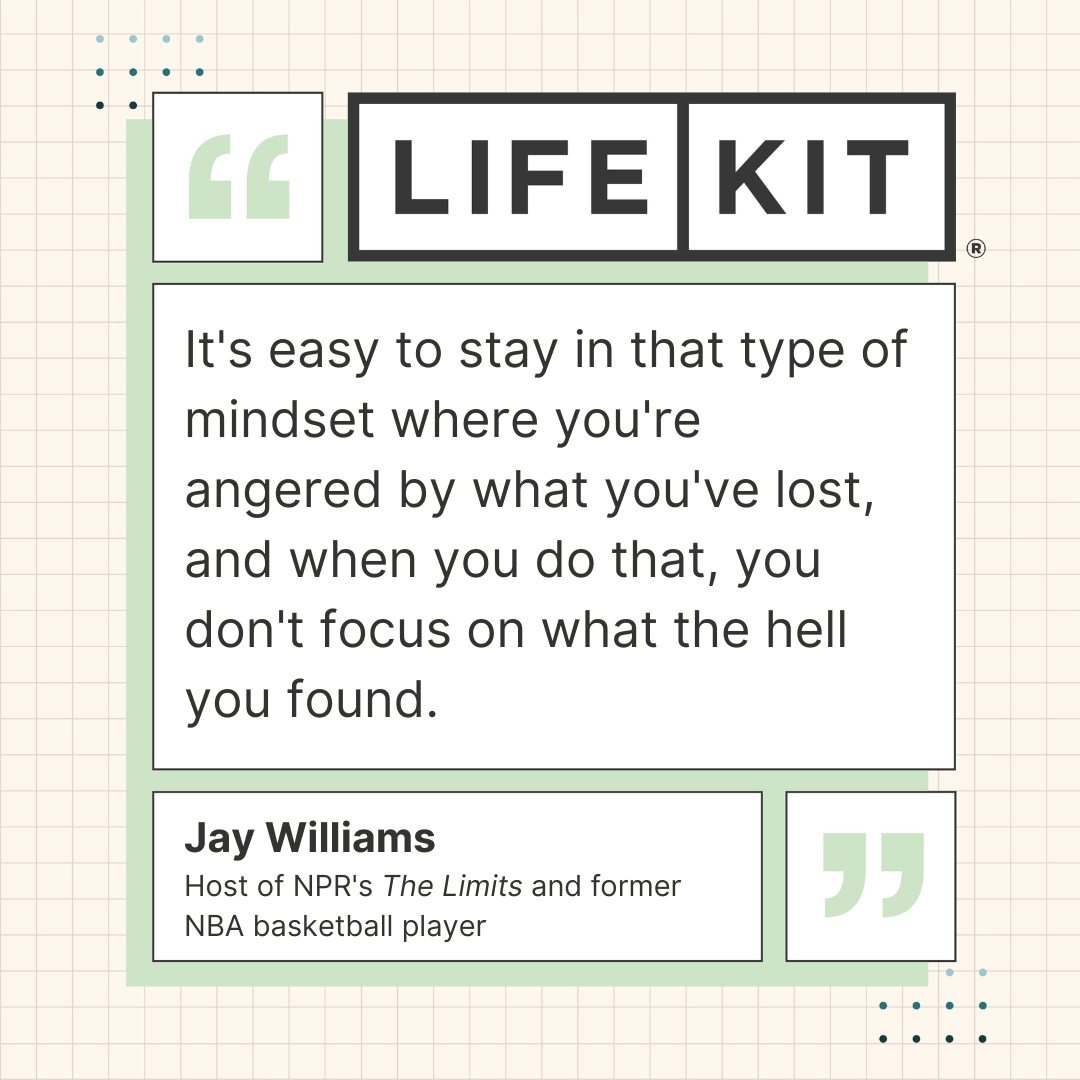
"It'south easy to stay in that type of mindset where you're angered by what you've lost, and when you exercise that, y'all don't focus on what the hell yous found," says Williams. "So it takes away my appreciation from the fact that I can walk. I can run. It may be painful, but I tin run with my daughter."
Williams decided to shift his perspective. Instead of sitting with the disappointment of the past, he's assail building for the future.
This idea is what psychologist Ballad Dweck popularized as a growth mindset, and it's a primal factor to being a adept loser. Where those with a fixed mindset volition focus on a final score and remember that talent and intelligence are static, growth-minded people believe that effort can lead to mastery.
"The great losers are the people who are able to recognize that a loss is just one pace in a process. But it doesn't need to be the last step," says Weinman.
Get a grip on reality, then brand a clear-eyed game plan
After a loss, it can be hard to divide the real from the imagined, to parse the stories our bruised egos are spinning from what really happened. Everyone blames me! I've brought shame to my ancestors!
When you're tempted to be overly disquisitional, Gooden says take a suspension and call back the final time yous noticed someone else's mistake. Did it actually affect you? Did you stay up all night thinking about their misstep?
"I like to remind my clients, and sometimes myself, that probably about 90 per centum of everything everybody does is about them and not most us," she says, "People are not talking for days and being like, Oh my gosh, can y'all believe they had a typo on slide three?"
Instead of beating yourself upwardly, focus on being as objective as possible. Fix aside your ego to build an honest flick of the reasons for your loss to do improve in the hereafter.
The deeper you lot dig in and the more than of your network you lot can include, the more than you can wait to grow. Maybe it'due south extra time with game tape with your coach, sending an email with specific questions to your interviewer, or – if you're actually dauntless – asking an ex what went wrong afterward a sudden breakup.
Just this debriefing flake isn't and shouldn't merely be about finding flaws, of course. You shouldn't have tunnel vision on your mistakes.
"And I think that'south actually a really important ingredient to losing well at times," Weinman says," sometimes you only need to chalk information technology up to a bad twenty-four hours or elements exterior of your control and have that and move on."
Practise perseverance. Training your losing muscle tin help a lot in the long run
Author and entrepreneur Jia Jiang constitute success through rejection.
It started with a rejection email. At the time, Jiang was the CEO of a software start-up and was in desperate need of capital. The email he received was from a potential investor proverb they wouldn't be moving forward.
"The starting time thought to pop up in my mind was, 'I want to quit. I'g non made for this," said Jiang. But so information technology dawned on him. "Would anyone successful feel this way? Would they want to quit right after rejection?"
Jiang decided if he was going to be a successful leader, he needed to shed his fright of rejection once and for all, and thus his project, 100 Days of Rejection was born.
Jiang committed to getting rejected every day in a dissimilar mode to meet what he would glean from it: he asked strangers for money, asked Krispy Kreme workers for Olympic ring donuts, asked people if he could plant flowers in their yard, asked pet shops for pilus cuts, and universities if he could teach classes.
The first day, in which he asked a stranger for $100, did not get well. "I started to sweat, my center started to pound, the hair on the dorsum of my neck stood up," Jiang said, "I was a total mess." He ran abroad as soon as he got a no.
"It was like a microcosm of my life," says Jiang, "the showtime thing I do is run away because I detest the fearfulness."
So the next day, he resolved to constitute his feet and meet what happened. Amazingly, that day and every day thereafter got a little bit easier.
"It'southward the running that feels bad, not the rejection itself," says Jiang, "too knowing you're not going to die actually helps a lot."
Jiang learned a lot from his project, but the message he pushes most is the importance of exposing yourself to small losses.

"You actually go trained to handle rejection," he says, "Yous can turn a 'no' into a 'yes' without losing your heed, without getting so tight, without getting so hurt.
And what's more? Jiang says y'all'd be surprised how much the world roots for yous when you put yourself out at that place – even if only every bit a loser.
"People want to say aye to yous and they want to have you succeed," says Jiang, "the globe is a lot more accepting and kind than I thought."
The podcast portion of this story was produced by Audrey Nguyen.
We'd love to hear from y'all. If you lot have a good life hack, go out u.s.a. a voicemail at 202-216-9823 or email us at LifeKit@npr.org . Your tip could appear in an upcoming episode.
If you beloved Life Kit and want more, subscribe to our newsletter .
Source: https://www.npr.org/2022/02/07/1078896034/how-to-lose-gracefully-and-turn-failure-into-opportunity
0 Response to "what to do when you are a complete failure and are a loser"
Postar um comentário