In the Power of Art Why Did Picasso Depict His Guernica as a Night Event Quizlet
Exactly eighty years ago, Pablo Picasso took on a committee that would forever change both his career and the unabridged outlook of modernistic art. The famous Guernica painting was painted by the Cubist painter in the June of 1937. Its championship refers to the city of the same proper name that was bombed by Nazi planes during the Castilian Civil War, an event that destroyed iii-quarters of the ancient boondocks, killing and wounding hundreds of civilians in the process.
Uncompromisingly honest in its brutality and underlined by the artist's signature visual style, Picasso'due south Guernica portrayed the horrors of war at their fullest and, as a issue, has come to exist a universal anti-war symbol.
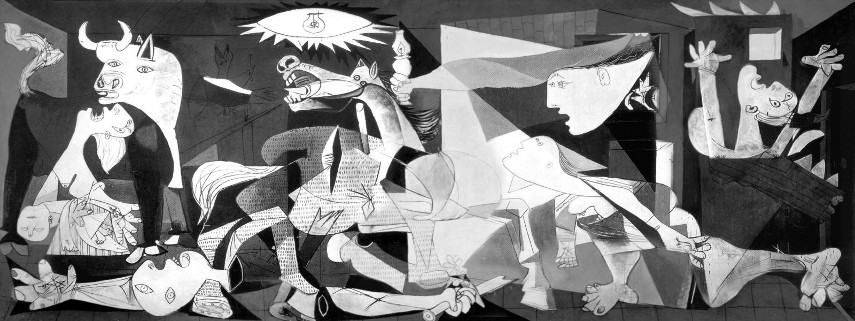
Guernica is a mural-sized oil painting many art critics consider to be one of the most moving and powerful anti-state of war paintings in history. Continuing at 3.49 meters (11 ft 5 in) alpine and vii.76 meters (25 ft vi in) broad, the painting shows the suffering of people wrenched by violence and anarchy. While numerous works by Picasso take been crowned every bit masterpieces, like Les Demoiselles d'Avignon (1907) which effectively set Western abstruse art in movement, Guernica stands lone in the artist's prolific oeuvre[1].
Towards Guernica - Pablo Picasso'southward Visual Experiments and Context
In the mid-1920s, around the fourth dimension Pablo Picasso became actively involved with Surrealism, he was mainly painting interiors with still lifes, featuring objects like musical instruments and fruits. He used these traditional themes to experiment with his ideas of breaking the form and presenting the limerick from multiple perspectives - aspects that soon became key to Cubism.
However, every bit Pablo viewed painting equally a personal experience that needed to correlate with the state of his inner life, the interior infinite of his works soon became claustrophobic. This shift occurred during World State of war I, a period Picasso and the Surrealists spent examining the nighttime corners of the human psyche. The Three Dancers (1925) is a prime example of Picasso's work of this era.
Another theme seemed to be quite vital to Pablo's body of work back and then - women. Notorious for his turbulent and numerous relationships, Picasso may take portrayed his lovers with affection in private works, merely his public pieces oft took a much grimmer perspective.
In the years leading upwardly to the cosmos of Guernica painting, other artworks and sketches reveal the artist'south ruminations on the symbolism conveyed through manipulation of the female torso — these experimentations, along with the aforementioned unique treatment of pictorial space, plant their natural resolutions in Guernica [2].
Guernica: What Inspired Pablo Picasso's Masterpiece? BBC History News Video
Why Do the Previous Works Matter So Much?
The reason nosotros insisted on speedily analyzing the painter's previous artistic stages is that, despite the fact Picasso's Guernica was indeed painted impressively rapidly, it didn't come out of nowhere. This painting is a issue of years of artistic production and visual experimentation, as well every bit the creative person'southward personal investment in the fraught politics of Spain.
Guernica was a culmination of Pablo Picasso's artistic endeavors and inner life, a piece that can not be examined without taking a wait at the bigger picture. In many ways, it tin be observed equally Pablo'southward crown piece - all of the visual features he became renowned for were placed inside Guernica's composition and no other painting of mod art reached the kind of cult status this artwork possesses.
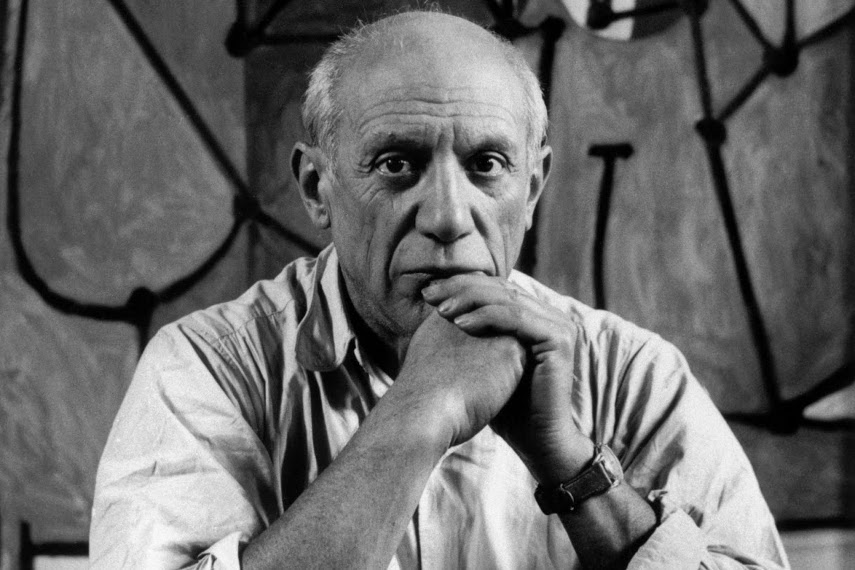
The Events Surrounding the Guernica Creation
The Spanish Republic, then in the midst of the Spanish Ceremonious War, had asked Pablo Picasso to create a painting for its pavilion at the Paris International Exposition of 1937. While the German and Soviet pavilions at the same event were gigantic architectural displays of authority and power, the Spanish Republic, desperately in demand of financial back up, opted for a modest structure filled with world-class modern art.
The Republic chosen upon authors at the forefront of the 1930s advanced, hiring artists like Joan Miró and Alexander Calder. Pablo Picasso accepted the commission without much thought in January 1937, agreeing to practice a mural-sized painting for his beloved Castilian Republic.
Interestingly, Picasso's original plan for his piece of work was incomparably apolitical despite the fact the Spanish Republic insisted that the piece must carry a potent political message. Non sure what he should paint at first, the artist initially prepared to create a composition depicting a painter in his studio, facing a nude model who lies on a sofa.
However, it was a tragic effect that inverse Pablo's heed, making him change the course of his pattern entirely.
Spanish Civil War 1937 - The Bombing of Guernica
On the 26th of April in 1937, Francisco Franco ordered the hired Nazi Condor Legion to drop bombs over the small town of Guernica. The bombing was to take identify during a marketplace 24-hour interval, which meant that civilians, predominantly women and children as men were off fighting the war, would be outdoors in public squares. As the first place where republic was established in Spain's Basque region, the town of Guernica was a symbolic target.
The brutal bombing that took place on that day killed hundreds of people and was the beginning example in the Spanish Ceremonious War in which a defenseless city was attacked. Similar endless others, Picasso opened his morning newspaper on April 27th to find images of the destruction of Guernica[3]. Pictures and stories covering the event devastated the artist who was at that fourth dimension already well-accepted to living in Paris, the Urban center of Light.
Since Picasso was a dedicated leftist and the idea of war lingered in his mind ever since he was criticized for not fighting in Globe War I, the bombing of Guernica struck him with a particular force[4]. After a few days of processing his emotions, he took to his studio on Rue des Grands Augustins and began new sketches for the Commonwealth's commission.
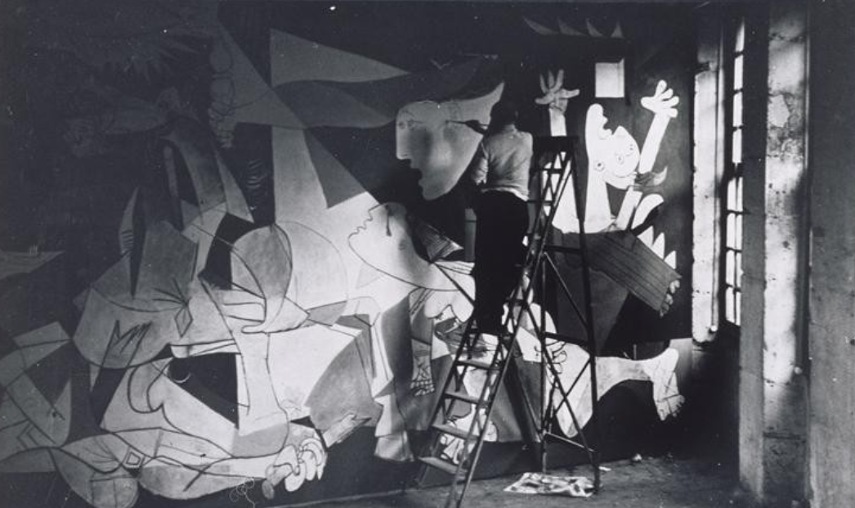
In just a calendar month and a half, the immense mural was completed - the Surrealist artist Dora Maar captured the various stages of the composition of Picasso'south Guernica in a series of photographs, some of which nosotros displayed in this article. In July, Picasso delivered the finished work to the Republican pavilion where it quickly became the centerpiece of the show, flanked past Calder's Mercury Fountain (1937) and Miro's The Reaper (1937), both of which can exist interpreted as pivotal pieces of the artists' careers.

A Motion-picture show of Human Tragedy
Guernica is painted in oil and in monochrome colors of black, grey and white, a characteristic that further emphasizes the weight of the depicted result. The flick is full of symbols and its overall theme is i of suffering. The piece portrays a frenzied tangle of six homo figures (4 women, a man and a child), a equus caballus and a bull.
Everything transpires within a claustrophobic low-ceiling space plant below an overhead lamp that appears to burst with brightness - this light bulb is believed to be a metaphor for the bombing as Spanish words for bombs and calorie-free bulbs sound adequately like.
Interestingly, hints of Picasso'south original limerick remained in the completed painting every bit Pablo opted to go along the initial traces of interior that was supposed to represent an artist'south studio.
Figures in Picasso'due south Guernica
While Picasso never made explicit to the public the symbolism behind each of Guernica'south figures and objects, much of it tin can be taken at face value despite the fact art historians love to split up hairs over the intentions behind virtually every brushstroke. Most directly figures are the contorted expressions of the women suffering concrete agony and ache. Their desperation is presented through sharp, pointed tongues and their sorrow through tear-shaped eyes.
On the far left of the Guernica painting, one adult female wails towards the sky while cradling a lifeless child in her artillery; another roars, her arms shooting up as she'due south consumed in flames; another emerges from an open window, wielding a torch and animate promise into the slice every bit if she's telling that all is not lost.
On the floor, a effigy who has been identified equally a soldier, lies in pieces, probably a personification of the fledgling Republic. He holds a flower in his manus[5].
While the figures of women and the soldier are conceptually quite straightforward, the balderdash and equus caballus have drawn varying interpretations over the years. Almost fine art historians like to trace the animals' roles back to the traditional Spanish bullfights where horses can become collateral damage at times and the balderdash is stabbed repeatably until death.
Still, some speculations have theorized that the bull, which lacks the emotional expression of the remainder of the figures, is an emblem of Franco or fascism. These theories indicate that it is precisely the bull that is trigger-happy the town apart, which would explain its emotionless eyes.
At that place are besides theories that merits Pablo was inspired past the Greek myth of Theseus and the Minotaur.
Pablo Picasso - Guernica (1937)
The Fate of the Picasso Painting
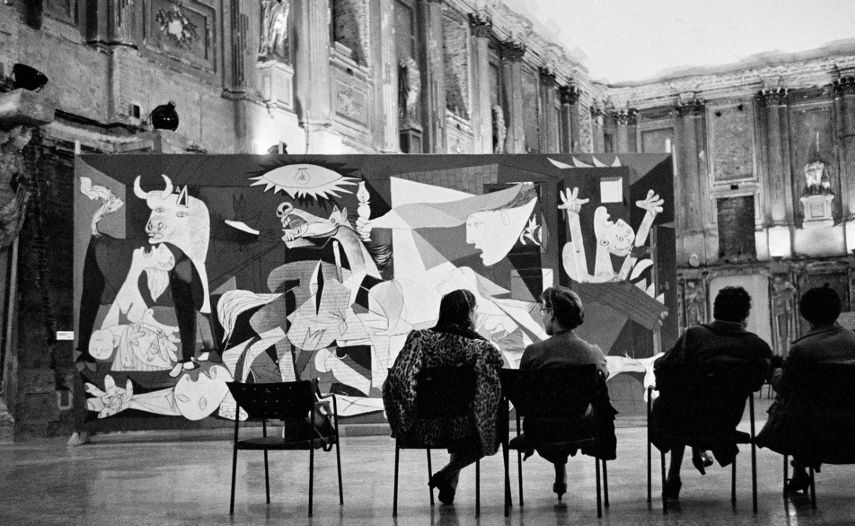
Following the closing of the Paris Expo, Guernica went on a tour in Europe. After the civil war ended and Franco took power every bit the Republic folded their arms, the painting continued to travel with aims of helping heighten funds for Castilian Republican refugees who had fled the country in fourth dimension. It was featured in the 1939 Picasso survey exhibition at the Museum of Modernistic Art in New York, after which Picasso would insist that MoMA act as Guernica's guardian from that point on[6].
Between 1939 and 1952, Picasso's Guernica traveled to art institutions across the United States, in Brazil and all over western Europe. In 1958, the piece was returned to MoMA and accounted no longer fit to travel - decades of send took its toll and left the painting in a precarious concrete state. Information technology remained in New York until 1981 when information technology was brought back to Spain, to Museo Reina Sofia, as per Pablo's wishes who insisted that the piece must non exist returned to the Castilian soil until Franco was dead.
Although this was a fairly personal reasoning, it also made a lot of sense for the safety of Guernica - the artwork would certainly be destroyed almost immediately if it came back during Franco'southward reign.
The Legacy of Picasso'due south Guernica
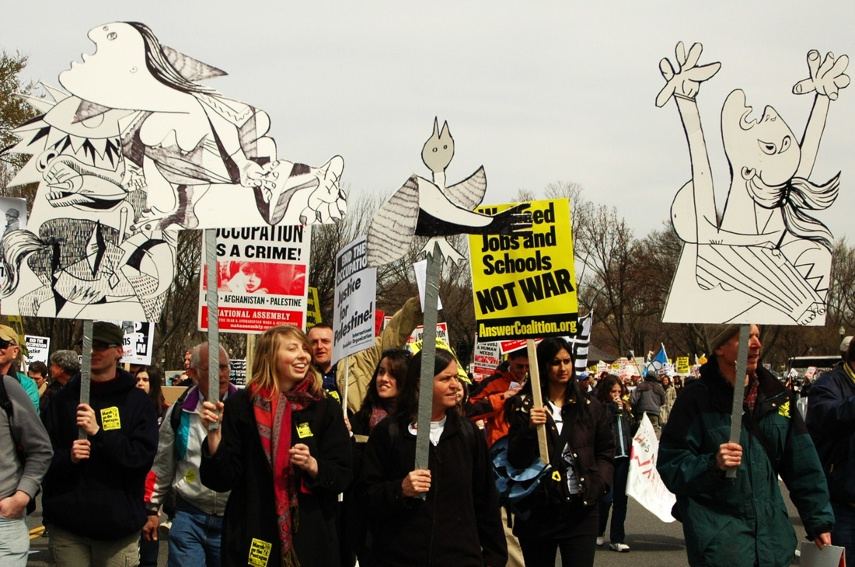
Interestingly enough, it was the time during which Guernica was stationary in New York Urban center that marked the painting'due south international rise in popularity, allowing it to take a life across the canvas[7]. The piece became synonymous with places where defenseless civilians came nether attack. And by doing so, it began to take on item resonance for anti-war protestors who began treating the piece as a source of motivation and the tragedy of the Spanish town as a reference.
The fashion Guernica shows the tragedies of state of war and the suffering information technology inflicts upon individuals became iconic and the mural became much more than fifty-fifty Pablo could predict - the painting gained a monumental status, becoming an embodiment of peace.
Picasso's Guernica is now a marking of humanity, a timeless piece whose frighting message is nevertheless understood by people all over the earth regardless of national, geographical or religious factors.
Exist sure to explore more works past Pablo Picasso on our marketplace!


Picasso 1926-1939: From Minotaur to Guernica focuses on a key phase of transition in Picasso's art, from his numerous depictions of the Minotaur myth in the late 1920s and early 1930s to his majestic and tragic 1937 masterpiece, Guernica. The Minotaur, independent in a labyrinth where information technology was fed Athenian youths, serves in part every bit a metaphor for subversive bestial drives under containment, but in Picasso's works on the theme, the Minotaur is set gratis into the world, where information technology oft finds itself stumbling and dumbstruck. This expression of destructive drives finally culminates in the terrible aerial bombing recorded in Guernica. From Minotaur to Guernica is authored by Catalan poet Josep Palau i Fabre (1917-2008), one of the artist's earliest admirers and experts, who has fabricated several close analyses of other phases in Picasso's prolific career.
References:
Featured image: Pablo Picasso - Guernica, 1937, image via Wikimedia Eatables. All images used for illustrative purposes only.
Source: https://www.widewalls.ch/magazine/pablo-picasso-guernica
0 Response to "In the Power of Art Why Did Picasso Depict His Guernica as a Night Event Quizlet"
Postar um comentário