Why Are College Papers Hard to Read
 Entering a new field of inquiry through reading oftentimes takes time. You don't get a sense of it all directly away and information technology is sometimes very hard to discriminate between the writing that is unfamiliar and deals with difficult ideas that really challenge and stretch our thinking, and the crappy stuff. Simply, Pat Thomson argues, information technology is important to do then.
It's a fact of scholarly life that some of the reading we do is just plain difficult. Sometimes this is because scholarly writing is obtuse, dense and, well, non really very skillful. But that's not ever the case. Sometimes the texts that we read are simply hard to grasp. That's because their writers are dealing with difficult ideas, it'due south non considering the texts are poorly written.
It's terribly easy to suggest that bookish writing that isn't transparently obvious at outset reading is, past definition, badly written. If it was well expressed nosotros'd understand it. It would be articulate and obvious. We'd get information technology straight away.
Well no. While that might sound logical, information technology'southward actually not e'er true. Getting into a new area or mode of thinking is actually a bit similar getting to know a new physical location. When you arrive in a new city you lot don't expect to know how to get effectually straight abroad. You don't expect to know a new place in the mode yous know your own home surround. Yous understand that yous have to make several trips before yous have a sense of what is where, and how to become from one place to some other without looking at a map for general directions and/or reassurance.
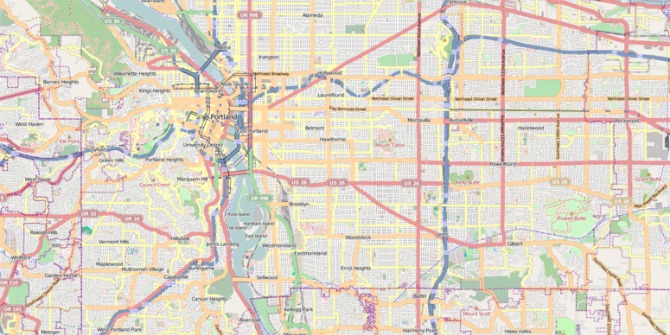 Prototype credit:OpenStreetMap Portland, OR Wikimedia CC Past-SA
And that's how it often is is with new literatures. You have to explore a chip. Y'all have to go a sense of what is where – the histories of debate, the lines of argument, the language used, the kind of questions that are asked, the topics that are pursued, perchance fifty-fifty the style of writing that is generally used in the field.
Entering a new field of inquiry through reading often takes the equivalent of several exploratory expeditions. You don't become a sense of it all straight away. Y'all have to get out and into it and get what you can. Each time you venture into the text, yous can see and understand more – yous become familiar with a piffling more, bit past bit.
It is sometimes very hard to discriminate betwixt the writing that is unfamiliar and deals with difficult ideas that actually challenge and stretch our thinking, and the crappy stuff. But it is important to exercise and so. These two are not the same thing. The first is worth persevering with, and the second not. I – the unfamiliar and complex – volition eventually advantage you lot, the 2nd volition never yield anything much worth knowing.
The difficulty of picking betwixt difficult and poorly written texts is peculiarly an upshot for people early on in their academic adventures. Doctoral researchers often discover that the books and papers that they encounter don't yield much at the start. And the PhDers don't necessarily know whether this is because they only aren't yet sufficiently at ease with 'the stuff' being discussed, or whether they've just happened across a text that is thick, slow and plodding and isn't worth pursuing.
The supervisor is the person to turn to if the difference between these 2 options is non articulate. Simply this doesn't mean asking your supervisor what the text means, but rather asking if the difficulty you are having with the text is a product of the writing or the ideas. You might want to talk to your supervisor virtually what you've understood so far in the problem text, because it is often in the talking that the reading becomes a little clearer. To proceed with the analogy, talking over a text is like going abode after a solar day out in a new city and debriefing with a friend. As you describe what y'all did, you retrieve almost the experience farther and things kickoff to autumn into identify.
The thing to know and understand is that all of united states of america come up across hard reading – and non merely during the doctorate. The reading doesn't just suddenly get easier once nosotros have a PhD. Whenever we encounter a new field, a new theorist, we are back into exploratory manner. We all often have to read a text several times, or read it very slowly, in guild to make real sense of it. But every bit the field becomes more than familiar, every bit nosotros know its conventions and its idiosyncrasies, the less difficult the reading becomes.
And we all have to recall that writing that intends to disrupt our usual ways of thinking, that aims to offering the states new approaches to understanding the world, and to provide different concepts and languages to those nosotros are accustomed to, may initially require a bit of work. And, forth the style, you lot do go much better at sorting out what is really not very good academic writing, and what is interesting and well worth your perseverance and patience. In that location is no excuse for poor academic writing, just there'southward reasons why some academic writing yields meanings to us more slowly.
This piece originally appeared on the author'due south personal blog and is reposted with permission.
Note: This article gives the views of the author, and non the position of the Impact of Social Science weblog, nor of the London School of Economics. Please review our Comments Policy if you accept any concerns on posting a comment below.
About the Author
Pat Thomson is Professor of Didactics at the Academy of Nottingham. Her current research focuses on creativity, the arts and modify in schools and communities, and postgraduate writing pedagogies. She is currently devoting more time to exploring, reading and thinking virtually imaginative and inclusive pedagogies which sit at the heart of change. She blogs about her research at Patter.

Source: https://blogs.lse.ac.uk/impactofsocialsciences/2015/04/28/why-is-this-reading-so-hard/
0 Response to "Why Are College Papers Hard to Read"
Postar um comentário